
MARMITE – The dark, sticky goo that has created its own advertising tagline of “Love it or Hate it”, and has been dividing the British public since its inception in 1902. (The Marmite Museum)
I feel Holacracy is exactly that, the Marmite of the self-management movement. You love it or you hate it. I know in my case I loved it when I learned about it at the beginning of my self-management journey 10 years ago and then I became a skeptic but I can appreciate its important contributions to the self-management movement. I have never have actually hated it, but it does have a halo that feels like Marmite.
Introduction to Holacracy
Holacracy by definition is the “power of the holons” (units that are autonomous and self-reliant but also dependent on the greater whole of which they are part). It is a self-management model created and trademarked by Brian Robertson.
Described on the official website as “a management framework with new rules of engagement”. Holacracy from a “managers perspective” helps identify and delegate tasks effectively, clearly defining roles and responsibilities allowing delegation while maintaining essential control, and provides a clear framework to lead effectively without micromanaging or becoming overly distant. On the other hand, Holacracy from an “employees perspective” provides a transparent governance that clarifies responsibilities, authority and boundaries empowering everyone to act decisively and efficiently, and offers a structured & efficient process to propose changes to such governance.
Holacracy has evolved in two different ways since I learned about it in 2018. The framework is based on a constitution which is updated, as a software operating system would. When I got trained on it the version was three point something and I can see that the latest version of the Holacracy Constitution is 5.0. The second was Holacracy has evolved is in the way they present and sell it to the world. In the past it was more of a “take it or leave it” all. It made sense to be honest, because once you implemented one part, let’s say the organisational design through roles and circle, you sort of needed the meetings structures, and so on. Now it feels like it is more of a “take what is useful” approach which has responded maybe to the criticism Holacracy has received in the past.
If you want to explore more about Holacracy from its creators, but also from external perspectives here are some resources:
- Holacracy company / website
- Holacracy TED Talk from Brian Robertson
- Conversations around Holacracy with Lisa Gill & Brian Robertson
My Experience with Holacracy
I heard about Holacracy for the first time through a course I took on “Gouvernance Partagée” with the Université du Nous in 2016 – 2017. Then I read the book Reinventing Organisations from Frederic Laloux where he shares the story of HolacracyOne, the company founded by Brian Robertson to steward the evolution of Holacracy.
Holacracy for me seemed like a perfect route to learn about self-management. Follow a recipe, the Constitution, and you are ready to go! I learn by doing so I proposed to my team, back then I had my own tourism consultancy agency, that we should adopt Holacracy as our new way of working. We were a distributed team of 5 people around Mexico, who hired more consultants and facilitators depending on the projects we had active. It all made sense for the operation of the company, so having read the book, reviewed the Constitution and watched a couple of YouTube videos we started our implementation. It was horrible! We couldn’t get heads around it, it was a bit confusing, and although we were using GlassFrog as a software to help us on our journey, we were getting a bit frustrated by the minute.
Until I went to San Francisco, USA, to get trained by the source of Holacracy himself: Brian Robertson. I first attended the Practitioners training, and then the Coaches training. The training really made the difference to understanding the logic and practice of Holacracy. I was a week together with practitioners from around the world and the interaction with the trainers as well as the trainees clarified how this thing worked.
Full of new knowledge I went back to my team and we implemented the whole framework and it worked! It worked for us. We engaged with the tactical and governance meetings. We clarified our operational roles. Used GlassFrog at a fullest potential. Our remote-first team was flying and it made sense to us and it made our workflow much more effective. It distributed power and there was a moment I left my original role as a “General Coordinator”, and someone else took the main role of “Lead Link” of the Central Circle.
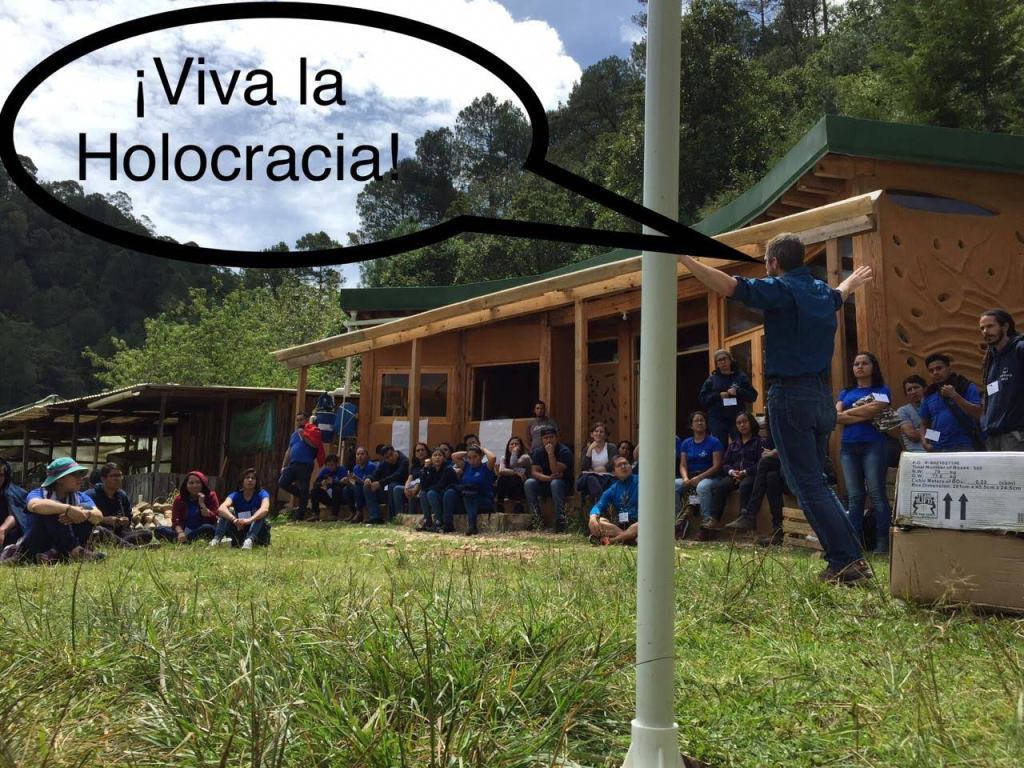
We were so excited about the model that I started sharing the idea with friends and founders of not-for-profit organisations in Mexico; and some wanted to learn about it. One organisation in particular really engaged with the idea, and its founder (and friend) Fermín Reygadas invited me to implement Holacracy in “Cántaro Azul”. A team member created the photo of this article back then making fun for my passion for the model.
Holacracy turned up to be marmite in this organisation. Some people engaged with the model and really took on them to use it, and some others completely were against it. To the extent they left the organisation! Probably not only for that reason, but it sounded like a good excuse. The part that resonated completely with some members, of a close to 100 people organisation, was the logic of roles and accountabilities, the tactical meetings, and the autonomy of people while energising their roles. The parts that generated a strong resistance was the idea that “organisations are built by roles (not people)”, the involvement in governance meetings that required to improve the description of roles and circles (more so if you where part of two or more circles), as well as the felt rigidity of needing to follow a constitution (a set of strict rules).
After its implementation in my consultancy company and in Cántaro Azul, I continued sharing the elements of the Holacracy model that made more sense for me. I really promoted the idea of roles descriptions, and the use of GlassFrog to adopt a set of practices around self-management. I would like to share more about the use of software to implement self-management, but I will do so in a next post.
“To Holacracy or not to Holacracy?”
…that is the question.
Personally, I would say yes to anyone considering it. Holacracy is a great training tool to explore self-management in a team without any previous experience. It requires reading the basic tenants and definitely at least one person trained appropriately to guide the team.
As anything, and everything, learn by doing and pick a choose what is useful to your creative field (initiative / company).
 The Organisational Gardener
Leave a comment