
Post written in June 30, 2025 for my Organisational Gardening newsletter
In every organisation, tensions are a natural part of working, not a sign of dysfunction, but a sign of awareness. A tension is what we experience when we notice a gap between what is and what could be. It might be a felt misalignment, an unspoken need, or a spark of potential not yet realised.
Tension lives in the observer, the one who senses something could be different, better, or more aligned. Sometimes this tension is about vision. Sometimes it’s about process. Sometimes it’s about people.
When we learn to name and work with tensions, they become not just disruptions to manage, but invitations to evolve. In this post, I offer a way to classify tensions and describe the four conditions that help us respond to them wisely in ways that nourish clarity, trust, and collective creativity.
🧭 Step One: Classify the Tension
If tension is the gap between what is and what could be, then the first step in working with it is learning to see it clearly. Where is this tension located? What is it pointing to?
Not all tensions are the same and not all require the same kind of response.
In Organisational Gardening, we can observe tensions in two essential dimensions:
- The Creative Field – the visible, structural dimension of how we organise and act together in the world. It includes our evolving purpose, roles, agreements, and working rhythms. What we’re building (doing) and how we build (do) it.
- The Social Soil – the dynamic, relational field beneath the surface of the work. It holds our trust, emotions, unspoken patterns, and sense of belonging. How we are with each other as we create.
Each of these dimensions can hold tensions. And each tension may relate to different aspects of the work:
- The Why (vision and intent),
- The How (collaboration), or
- The What (behaviours).
To make sense of this, we use the following matrix.
🌾 Tension Classification Matrix
When we observe tensions in the system of an organisation, they tend to arise from a mismatch between intention and reality; between what we sense should be happening, and what is actually unfolding. This matrix helps us classify tensions across the Creative Field and the Social Social.
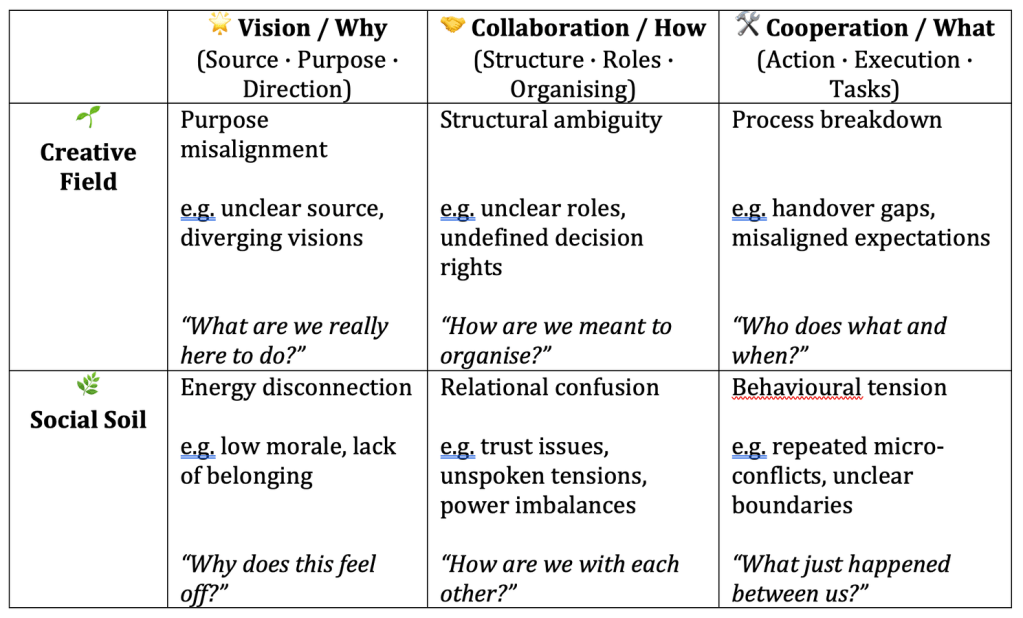
Tension Classification Matrix
This matrix is not a diagnosis tool — it’s a sensing map. It helps us notice where a tension might be rooted and opens up the question: What kind of care, process, or conversation might this tension be asking for?
🌱 Conditions for Processing Tensions
Once we have named and classified a tension, the question becomes: what conditions allow us to work with it productively, rather than letting it fester or bypassing it altogether?
In an organisation, processing tensions requires more than tools or frameworks. It needs an environment (a space) with a process where tensions can be acknowledged, explored, and addressed with care and clarity. In Organisational Gardening, we focus on four essential conditions:
🛡️ 1. Safety
Psychological safety is the foundational soil where tension work can begin. As Amy Edmondson defines it, psychological safety means people feel safe to speak up with ideas, concerns, or mistakes without fear of blame or shame. Google’s Project Aristotle found it to be the most critical factor for effective teams.
Vulnerability, as Brene Brown reminds us, is not weakness, it is the courage to show up with uncertainty and honesty. Events like Fuckup Nights help normalise this by creating public rituals of learning through failure. In a team or organisation, safety doesn’t mean comfort. It means knowing that naming a tension will be met with curiosity, not punishment.
👁️ 2. Visibility
Tensions that remain hidden can’t be addressed. Visibility means we have shared ways to bring tensions into the light — whether that’s through a question in a check-in, a role review, a retrospective, or simply a moment of reflection where someone says: “Something doesn’t sit right.”
Making tensions visible doesn’t require perfect language. It requires enough safety and self-trust to express what we’re sensing. Over time, visibility becomes a practice of collective seeing — where different perspectives help complete the picture.
✅ 3. Permission
Even when tensions are visible, we often hesitate to engage with them. That’s why permission matters, both internal and external. Internal permission is the sense that my perception matters. External permission is the sense that the group welcomes this kind of input.
Teams and organisations can support permission by explicitly saying: “We want to hear the hard stuff.” They can embed it into meeting formats, agreements, and culture affirming that anyone can name a tension, not just the most senior, confident, or seasoned voice.
🔁 4. Practice
Finally, working with tension is not a one-time fix it is an ongoing practice. Like any muscle, it strengthens with repetition. Like any garden, it needs regular tending.
Practice means developing shared rhythms for checking in, reviewing roles, updating agreements, and learning from what’s not working. Teams that process tensions well don’t eliminate them — they become better at navigating them. They learn to listen to the system, respond without reactivity, and evolve through the feedback life is offering.
When these four conditions (Safety, Visibility, Permission, and Practice) are present, tension becomes not a pest or weed, but a fellow gardener. It becomes possible to respond rather than react, to inquire rather than defend, and to learn rather than blame. In this way, tensions invite us to continuously evolve our ways of working, relating, and creating. Rather than pushing them aside, we begin to relate to them as part of the life force of the organisation itself.
🌻 Final Thought
Tensions are not interruptions to the work. They are the work of the Organisational Gardener.
Each one carries a signal — a gap sensed by someone in the system between what is and what could be. In Organisational Gardening, we don’t try to eliminate tensions. We learn to listen to them. We tend to them with care. And we welcome them as part of the system that wants to grow through us.
Tension is not a pest. It is a companion in cultivation: a fellow gardener reminding us that something over or beneath the surface is asking for attention.
Step 2, how to process tensions, will come soon…
 The Organisational Gardener
Leave a comment