

Post written in June 9, 2025 for my Organisational Gardening newsletter
In many organisations today, collaboration is confused with simply doing work together. Even worse, it is confused with working next to each other, whether physically or virtually. Interactions are transactional, and creativity, when it appears, is often short-lived. Gallup’s research consistently shows that employee engagement remains stubbornly low worldwide. The reality behind the numbers is felt in underperforming teams, stifled innovation, and a disengagement crisis that no amount of new technology seems able, or will be able, to fix.
As George Karseras points out, over 90% of teams underperform. They lack a clear sense of purpose and the psychological safety that enables knowledge sharing, initiative, and creative risk-taking. In this context, we need a different approach to building or renewing teams. One that acknowledges the living nature of how we organise. We also need another definition of performance.
I truly believe that learning is the new performance. Outputs and outcomes are certainly important to measure whether we have reached a destination. However, it is the learning journey that becomes the most important aspect to sustain growth and harvest results.
Organisational Gardening offers this alternative metaphor. It moves us away from seeing teams as objects to be built or optimised and toward seeing them as living systems. Importantly, it reminds us that what we are gardening is not people, nor even teams themselves. We are gardening how we organise: as individuals, as teams, and as teams of teams. We are cultivating the fields where collaboration, creativity, learning, and performance emerge.
What Are We Gardening?
In Organisational Gardening, we work with two key elements: the Creative Field and the Social Soil.
The Creative Field is the emergent, above-ground space where new initiatives, ideas, and innovations take root. Drawing on ideas from Field Mapping and Tom Nixon, the Creative Field is the energetic space created when people come together around a vision. It is where attention, intention, and energy converge to give rise to something new. We can also see parallels with the Sky and Sunshine Zones described in Depth Finding work by The Ready. These are the visible, high-energy areas where creativity and growth are most apparent.
Beneath the surface lies the Social Soil. This is the invisible but vital relational dynamic that sustains collaboration. Inspired by Otto Scharmer‘s work on systems change, Social Soil includes trust, psychological safety, communication norms, and power dynamics. These are harder to see but are essential to healthy collective work. In Depth Finding terms, this corresponds to the Twilight and Midnight Zones, again from the Ready. Here we find deeper layers where assumptions, habits, and systemic patterns reside.
Healthy Creative Fields cannot thrive without fertile Social Soil. Much of the unseen work of gardener-leaders is to tend these underlying dynamics while cultivating the visible field above.
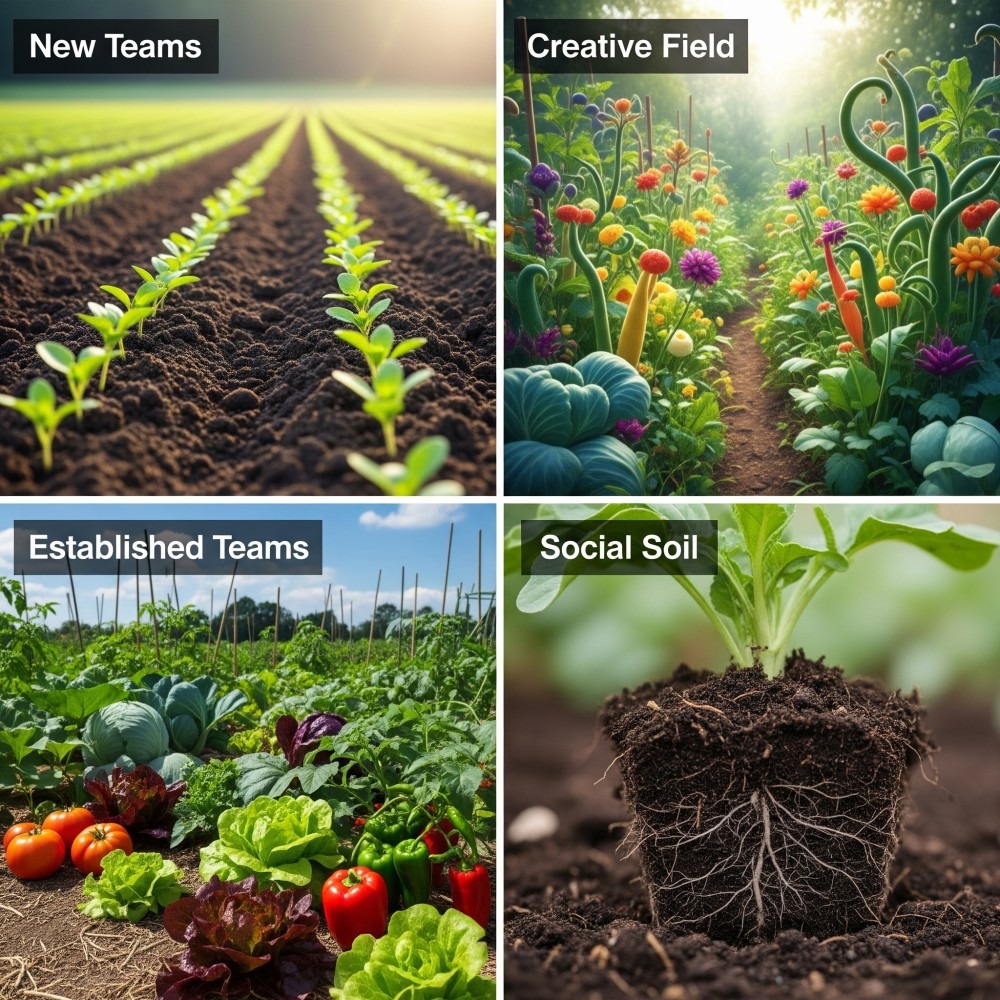
What are we gardening?
The Cultivation Cycle for New Teams
New teams are like newly opened fields. Energy is high, but the soil has not yet been tested. For these teams, Organisational Gardening follows a four-phase Cultivation Cycle: Sowing, Nurturing, Harvesting, Composting.
We can describe this cycle in the following way and identify other team building or developing frameworks and practices that relate to these phases:
Sowing: This is the moment of sharing the vision and co-creating it. It is also the phase where trust is built and basic team agreements are established. This phase aligns with the Get Safe and Get Set stages proposed by George Karsears. Practices such as Playbooks, role-based models like #Holacracy from HolacracyOne, and desired behaviours expressed in working team agreements (such as those developed by Helen Sanderson MBE) are valuable tools at this stage.
Nurturing: This is the phase where the team puts into practice and co-evolves its working habits, decision-making capabilities, and mutual support structures. It parallels the Get Strong stage of Karseras’ model. Agile practices such as retrospectives are key, not only to improve the work to do, but also to improve how collaboration happens.
Harvesting: The team achieves early wins and desired outputs towards the bigger outcomes. It celebrates learning and consolidates trust.
Composting: This is an essential addition. It involves creating space for reflection, integrating lessons learned, and allowing closure. This ensures that the Creative Field and Social Soil are replenished for future cycles. Composting ideally happens at regular intervals. It is not the five-year strategic meeting, nor the annual review. It is more frequent, such as an end-of-sprint or end-of-quarter feedback loop.
The role of the gardener-leader at each stage is not to force growth but to cultivate the right conditions.
In the early stages, this means creating spaces for open dialogue, aligning shared intentions, and encouraging risk-taking and learning. Later, it involves having the mechanisms for the team to harvest more achievements and intentionally regenerating the field for the next cycle of work.
The Extended Cycle for Existing Teams
Working with existing teams requires a different approach. These teams already have established patterns, some healthy and some less so. A gardener-leader entering this space must first observe and clear before sowing new seeds. The extended Cultivation Cycle becomes: Observing, Clearing, Sowing, Nurturing, Harvesting, Composting.
Observing: The first step is to map both the Creative Field and the Social Soil. For the Creative Field, practices like Creative Field Mapping and tools such as Maptio help visualise current initiatives, relationships, and energy focus. For the Social Soil, the Operating System Canvas helps surface organisational tensions and patterns in how the team works together. Diagnostics such as CultureSee offer lenses to understand deeper cultural patterns and relational dynamics. Another useful tool can be the Learning Power assessment from WILD to understand the learning profile of individuals and the team.
Clearing: Once the landscape is visible, Clearing involves liberating trapped energy and making space for renewal. For work and initiatives, EcoCycle Planning helps teams identify what is thriving, what is stuck, and what must be composted. The goal is to clear initiatives that no longer serve the evolving vision and to refocus on what generates true value. For relational and social dynamics, deeper work is often needed; this includes individual and team #coaching, Money and Source Work, #NVC or maybe even Restorative Justice practices. These help address underlying tensions, restore trust, and rebuild the Social Soil.
Only after careful observation and clearing is it possible to sow new seeds, nurture fresh growth, harvest results, and compost again for ongoing renewal.
Final Words
In Organisational Gardening, growth is not controlled. It is cultivated. Gardener-leaders do not micromanage individuals or teams. Instead, they create and maintain the conditions for collaboration, creativity, learning, and contribution to flourish.
In a world where work increasingly happens in teams of teams, the ability to tend the Creative Fields and Social Soil becomes a critical leadership capacity. It is not the individuals that we garden, nor even the teams. It is the spaces between us, the fields where meaningful work and human connection emerge, that require our care.
Reflection Prompt: “Where is your creative field calling for cultivation? Where does your social soil need renewal?”
List of Resources
- Gallup Research – Employee Engagement Data – Gallup Workplace Engagement
- George Karseras – TeamUp Four Stages of Team Development (Get Safe, Get Set, Get Strong, Get Success) – TeamUp by George Karseras
- George Karseras‘s book “Build Better Teams: Creating winning teams in the digital age“.
- Field Mapping – Creative Field Concept – Field Mapping
- Work with Source – Source Work and Creative Field Concept – Work with Source
- Depth Finding – The ReadySky, Sunshine, Twilight, Midnight Zones – The Ready – Depth Finding
- Otto Scharmer – Presencing Institute – Social Soil and Systems Change – Otto Scharmer – Systems Change
- Maptio – Initiative and Relationship Mapping – Maptio
- Operating System Canvas – Mapping Organisational Tensions and Structures – Brave New Work – Operating System Canvas
- CultureSee – Organisational Culture Diagnostics – CultureSee
- Learning Power -Learning Profile of Individuals and Teams – Learning Power – WildLearn
- Ecocycle Planning – Liberating Structures – Identifying Life Cycles of Projects and Initiatives – Ecocycle Planning
- Conscious U – CUMoney and CU Source – Money Work and Source Work for Teams – CU*Money, CU*Source
- Nonviolent Communication (NVC) – Conflict Resolution and Communication Skills – NVC – Center for Nonviolent Communication
- Restorative Justice – Compassionate Conflict Management and Workplace Justice – Workplace Peace Institute – Restorative Justice
- Helen Sanderson – Team Agreements and Behavioural Frameworks Konsileo case study – https://player.captivate.fm/episode/93d8c80e-c970-4cce-97f7-9efb6d06f54f/
 The Organisational Gardener
Leave a comment